Preview


Description
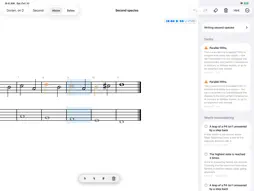
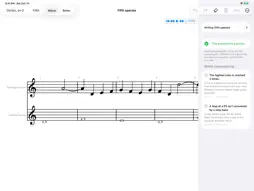
Gradus teaches species counterpoint, the discipline every composer from Haydn to Brahms learned from, and it grades your work as you write. Choose a cantus firmus, write a line above or below it, and Gradus checks every note against the rules of strict counterpoint. Parallel fifths, an unprepared dissonance, a leap that never resolves: each fault is marked on the staff and explained in plain words beside it, with what to try instead. TWO PART COUNTERPOINT, AS FUX TAUGHT IT • All five species: note against note, two notes, four notes, suspensions, and florid counterpoint • Fux's six cantus firmi, in the Dorian, Phrygian, Lydian, Mixolydian, Aeolian and Ionian modes • Write above the cantus or below it, where your line becomes the bass • The cambiata, ornamented suspensions, the Phrygian close and Lydian's B flat, each handled as Fux handles them GRADED THE WAY A GOOD TEACHER WOULD • Faults and cautions are kept apart: what is wrong, and what is worth reconsidering • Each rule says where it comes from. Fux's own rules are marked as his; habits added by later teachers are marked as later practice, so you know which is which • Checked against Fux's own worked answers from the 1725 Gradus ad Parnassum, which Gradus accepts as written • A guide for each species sets out what it asks for before you start HEAR WHAT YOU WRITE • Play your exercise on strings, or switch to pure tones to hear the intervals themselves • Choose the tempo, step bar by bar, pause and carry on • Hear the cantus firmus alone, your line alone, or both together WHEN YOU'RE STUCK • Ask for a hint, or have Gradus finish your line from where you are • Undo and redo everything ON IPAD AND MAC • On iPad, write with Apple Pencil, or tap to place a note and drag it to move it • On Mac, click to write, drag to move, and use the keyboard for accidentals • One purchase covers both Export any exercise as PDF, as MusicXML, or as an Autograph score. Every exercise saves itself as you go. No account and no subscription. Gradus collects no data. For writing music freely, try Autograph, our notation app for iPad and Mac.
What's New
Version 1.3 2026-10-24
FOURTH SPECIES • Write both halves of every bar. The line opens with Fux's half rest and enters on the second half of bar 1. • A downbeat written at the pitch a...FOURTH SPECIES • Write both halves of every bar. The line opens with Fux's half rest and enters on the second half of bar 1. • A downbeat written at the pitch already sounding is tied over by itself, whichever note you write first or drag into place, and a tie whose notes no longer match is taken off. • Two or more downbeats in a row struck rather than tied are marked as a caution: the tie is broken. • Hints and Finish my line hold the note over into a suspension, as Fux does, rather than writing second species. FIFTH SPECIES • Buttons for the whole, half, quarter and eighth note, beside the music whenever a florid exercise is open. • A click a little short of the end of a held note writes after it, instead of cutting it short. • A note can no longer run over the barline. One already saved that does is marked. • New cautions: a half note starting on a weak beat, the same note struck twice in a row, and a cadence with no suspension. CLEARER EXPLANATIONS • A dissonance reached or left by a leap says which leap, and on which side. • A suspension that does not fall a step says it was held over and where it went, instead of calling it a leap. • A note held over with nothing after it yet is a suspension waiting to resolve: a caution to fall a step, not an error. • Second, third and florid species: perfect fifths or octaves on two downbeats in a row, with a leap of a fourth or more between them, are now a caution. Fux allows them, but most later teachers do not. The second species guide now says so too. • Two notes with a stretch of unwritten bars between them are no longer judged as a leap. ON THE PAGE • A natural is drawn when a note goes back to natural after a flat or sharp earlier in the bar, and playback follows it. PLAYBACK • Clarinet and horn join violin, viola and cello. • Bring out one line, so it sounds above the other, and turn either line off to hear the other alone. Both are in Settings under What plays, as well as in the menu. • Changes to the tempo, the sound, the instruments or what plays are heard at once, without starting again. • On iPad, the bar being played is highlighted again, in step with the sound. • Fixed a crash when playback restarted while playing. ON IPAD • Your exercises are in the Files app, under On My iPad > Gradus, so you can copy or share them. • The note value buttons are larger and easier to press, and so are the flat, natural and sharp. • If your saved exercises ever cannot be read, they are set aside rather than overwritten. Technical Analysis
Package Overview Basic metadata
Bundle ID
com.timothywilliams.Gradus Current Version 1.3
Minimum iOS 17.0
Package Size App Store Size
Package Metadata 0 / 0 version records
Detailed binary, privacy manifest, framework, and Info.plist results have not been indexed for this package yet. The verified App Store and archive metadata above remains available.
Developer Information
Known Version Records
0 version records with stored package metadata
Stored metadata does not guarantee a package is currently available to download.
| Details | Version / IDs | Version date | Action |
|---|