Preview





Description
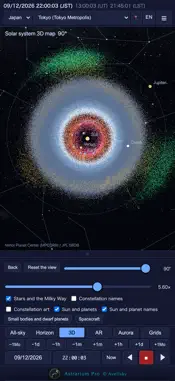
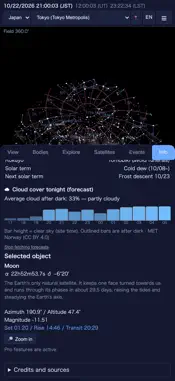
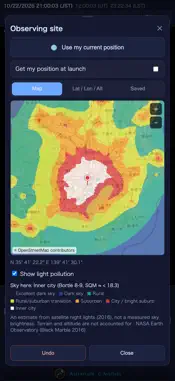
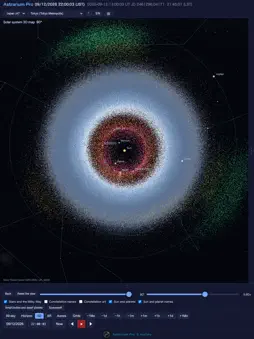
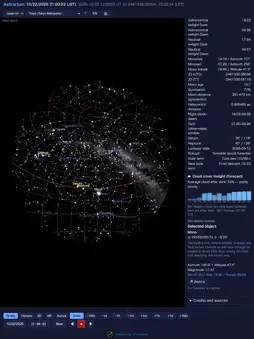
Choose a place and a time, and Astrarium draws that sky. Every position is computed on the device, so it works where there is no signal. The network is used only for comet and asteroid elements (MPC, JPL), satellite elements (CelesTrak), observed comet magnitudes (COBS) and the place picker's map tiles (OpenStreetMap) — each on your own action, each falling back to the cache. IN 11 LANGUAGES Japanese, English, Chinese (Traditional and Simplified), Korean, Spanish, Portuguese, French, German, Czech and Polish — the interface, and the names of constellations, stars, places and countries with it. CATALOGUES (all bundled) • 9,096 stars — Yale Bright Star Catalogue, to magnitude 8: all the naked eye can see • 155 nebulae, clusters and galaxies — Messier and Caldwell, with photographs • The 88 IAU constellations: 752 line segments from the official figures, and the classical art • The Milky Way, from NASA's Deep Star Maps 2020 — the light of 1.7 billion stars • Deep star catalogue — 2.34 million UCAC4 stars to 12th magnitude, appearing below a 12-degree field • Planets and the Moon from JPL DE421, with surface maps, libration and lunar age • 16 major meteor showers, MPC observatory codes, sites worldwide WHAT IT DOES • Whole-sky and horizon views, pinch zoom to an arcminute • Jump to any date, run the clock to 6000x, step by synodic month • Planet close-ups: apparent diameter, phase, distance, orbital elements, and the moons of Jupiter, Saturn and Mars • Meteor shower calendar: maximum in local time and UT, radiant altitude, moonlight, and an expected hourly rate from the ZHR • Comets and asteroids from the MPC and JPL • Satellites: the space stations and the naked-eye ones, with visible-pass predictions. Elements (TLEs) come from CelesTrak — refresh with “Download / update TLEs”, then it is all offline • Four coordinate grids, the ecliptic, equator, galactic plane and meridian, FOV frames for smart telescopes and lenses • Switch each layer on its own — lines, names, stars, Sun and planets, deep-sky objects, the Milky Way, the figures • Limiting magnitude that follows twilight and moonlight, red night-vision mode, PNG/PDF export, a captioned demo LOCATION Your position is used only to compute the sky where you are, and never leaves the device. Decline it and pick a site or type coordinates: nothing is lost. No ads, no account. All of the above is free, with no time limit. AR — the chart over the camera image — is free too. Sources and licences are listed under Credits. ASTRARIUM PRO (OPTIONAL SUBSCRIPTION) For observers who want to go deeper, an in-app subscription adds: • 3D solar system map — 1.58 million small bodies, comets and spacecraft, from above the ecliptic • Aurora forecast — NASA DONKI and NOAA OVATION, the oval on the sky and on a globe • Proper-motion time machine — 50,000 years either way; the figures come apart • Exoplanet transits, variable-star maxima and minima • Every satellite group (Starlink, weather, science…), the world map and globe, search by name or ID • Equidistant (dome master) projection, local sidereal time US$3.99 a month or US$39.99 a year (US; prices vary by region). The first week is free; cancel any time. Payment is charged to your Apple ID at purchase and renews automatically unless cancelled at least 24 hours before the period ends. Manage or cancel in Settings > Apple ID > Subscriptions. Any unused part of a free trial is forfeited on purchase. Terms of Use (EULA): https://www.apple.com/legal/internet-services/itunes/dev/stdeula/ Privacy Policy: https://astrarium.pages.dev/privacy-policy.en APPLE WATCH Install it on iPhone and it goes to the watch too — free, like the rest. Tonight at a glance: when it gets dark and light again, the Moon's age and rise and set, which planets are up and where, the next satellite pass, any shower running. Plus a chart holding the whole sky in one disc, which the Digital Crown moves twelve hours either way.
What's New
Version 2.3.2 2026-11-02
• New dwarf planet candidate 2026 ED138 — the Vera C. Rubin Observatory's first — on the sky chart and in the 3D solar system map, with a description. • Aurora:...• New dwarf planet candidate 2026 ED138 — the Vera C. Rubin Observatory's first — on the sky chart and in the 3D solar system map, with a description. • Aurora: the colours and heights now come from a physical emission model (Fang et al. 2008; Zhang & Paxton 2008), and the sky is drawn with the live NOAA SWPC Kp index. • The 3D map's asteroid data has been refreshed from the latest MPC catalogue (1.58 million objects). Technical Analysis
Package Overview Basic metadata
Bundle ID
com.avellsky.astrarium Current Version 2.3.2
Minimum iOS 17.0
Package Size App Store Size
Package Metadata 0 / 0 version records
Detailed binary, privacy manifest, framework, and Info.plist results have not been indexed for this package yet. The verified App Store and archive metadata above remains available.
Developer Information
Known Version Records
0 version records with stored package metadata
Stored metadata does not guarantee a package is currently available to download.
| Details | Version / IDs | Version date | Action |
|---|