Preview


Description
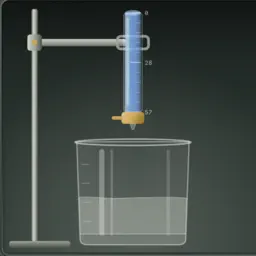
Curve Flow Control is a titration puzzle built on real equilibrium chemistry. Every pH value, every colour change, every point on the graph is computed from the same equations used in analytical chemistry laboratories. A beaker of acid sits on a dark bench. A burette above it holds sodium hydroxide. A vertical slider controls how fast the base drips in. The player drags it upward — drops begin to fall, then a thin stream. A live curve builds on the graph below, plotting pH against volume added. In the early region the curve is nearly flat. The player can move fast here. But somewhere ahead, the curve will turn vertical — the equivalence point, where a fraction of a millilitre changes the pH by eight units. The only way to hit that point precisely is to anticipate it. The curve itself is the signal. When the slope begins to steepen, the player slows the slider. A single drop. Two drops. The pH display ticks past 6.8, 6.9, 7.0. The beaker transitions from clear to pale pink — the phenolphthalein indicator crossing its threshold at exactly the right moment. Score. Three titration systems, each with a completely different challenge profile. Strong acid against strong base produces the sharpest inflection in chemistry — within the target zone, the pH changes at forty units per millilitre. The player who arrives at 49 millilitres still running at three millilitres per second will overshoot by twelve millilitres before they can react. Weak acid against strong base introduces the buffer region — forty millilitres of flat, change-resistant curve where the player can run at full speed. The Henderson-Hasselbalch equation governs this region, and at exactly the halfway point, the pH display reads 4.74 — the pKa of acetic acid, derivable from the graph if the player is watching. The equivalence point lands at pH 8.72, not 7, which most players do not expect. The diprotic acid level uses carbonic acid — the molecule that regulates blood pH. Two equivalence points separated by a second buffer plateau. The player must slow down twice, read two separate inflections, and hit both target zones. The chemistry simulated is the acid-base system keeping human blood at pH 7.4. The game teaches the shapes of titration curves not by describing them but by requiring the player to navigate them under time pressure. After three levels, the S-curve is no longer a textbook diagram. It is something the player has felt.
Technical Analysis
Package Overview Basic metadata
Bundle ID
com.kelvincopeland.curveflowcontrol Current Version 1.0
Minimum iOS 18.0
Package Size App Store Size
Package Metadata 0 / 0 version records
Detailed binary, privacy manifest, framework, and Info.plist results have not been indexed for this package yet. The verified App Store and archive metadata above remains available.
Known Version Records
0 version records with stored package metadata
Stored metadata does not guarantee a package is currently available to download.
| Details | Version / IDs | Version date | Action |
|---|