Description
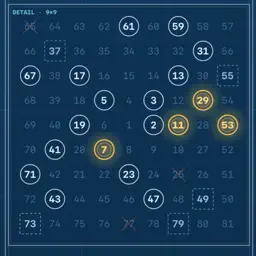
Prime Spiral Glow gives you a grid of numbers and a question — which of the hidden ones are prime? In 1963, mathematician Stanislaw Ulam was sitting through a dull conference and began doodling. He wrote the integers in a square spiral and circled the primes. What he saw was unexpected: the primes formed diagonal lines. Not random scatter — actual straight lines running through the grid at forty-five degrees, denser along some diagonals than others, in patterns that no simple theory fully explains. He published his observation. It became one of the most reproduced images in number theory. The arrangement is now called the Ulam spiral, and the patterns it reveals are connected to some of the deepest unsolved problems in mathematics. Prime Spiral Glow puts that spiral on your screen. Known prime cells glow warm amber with a soft bloom around them. Known composite cells — the non-primes — recede into the dark background, barely visible. Between them sit the hidden cells, pulsing gently: numbers whose prime or composite status the player must determine. Tap a hidden cell if you believe it is prime. If you are right, it erupts gold and joins the constellation. If you are wrong, it flashes red. Three wrong taps and the game ends. The difficulty comes from the composites chosen to hide alongside the primes. They are not the obvious ones. Multiples of two are immediately recognisable and are never hidden. The hidden composites are odd numbers with no small visible factor — 25, 35, 49, 77, 91, 119, 143 — numbers that require genuine reasoning to dismiss. Is 91 prime? It is not — it is seven times thirteen — but it does not feel composite at first glance. The tools the game teaches without naming them: every prime greater than three is either one above or one below a multiple of six. This eliminates two thirds of candidates immediately. Beyond that, testing divisibility by small primes — seven, eleven, thirteen — handles most of the rest. Players who complete the first few puzzles find themselves doing this automatically, building genuine number sense through repetition and feedback. When all hidden primes are found, the remaining hidden composites fade to dark. Then the diagonal lines ignite. Glowing beams trace across the spiral, connecting primes that fall along the same algebraic curve. The most brilliant diagonal in the spiral corresponds to a polynomial discovered by Euler in 1772 that generates forty consecutive prime numbers before finally producing a composite. In the spiral, this diagonal is nearly unbroken — a streak of gold running corner to corner. Seeing it complete is unlike anything else in a puzzle game. Four spiral sizes progress from a seven-by-seven grid of forty-nine numbers to a thirteen-by-thirteen grid of one hundred and sixty-nine. The outer rings contain larger numbers, larger prime gaps, longer stretches of composite between the gold cells. The galaxy grows sparser and more beautiful as it expands. No ads. No calculator needed. No prior knowledge of number theory required. The numbers are small enough to test mentally. The patterns are visible enough to guide the search. Just the spiral, the hidden cells, and the diagonals waiting to be found.
Technical Analysis
Package Overview Basic metadata
Bundle ID
com.kamilciesla.primespiralglow Current Version 1.0
Minimum iOS 18.0
Package Size App Store Size
Package Metadata 0 / 0 version records
Detailed binary, privacy manifest, framework, and Info.plist results have not been indexed for this package yet. The verified App Store and archive metadata above remains available.
Known Version Records
0 version records with stored package metadata
Stored metadata does not guarantee a package is currently available to download.
| Details | Version / IDs | Version date | Action |
|---|