Preview





Description
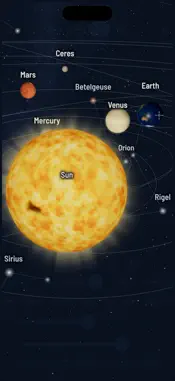
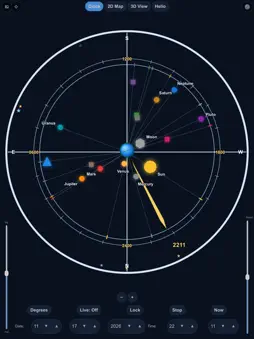
Celestial Cosmos shows you where everything in the solar system actually is — right now from where you are standing, or on any date you care to name. A 24-hour dial puts you at the centre with the Sun, Moon, planets, bright stars and constellations placed by true compass direction and altitude. One glance tells you what is overhead, what has set, and what is about to rise. Then move the date and time and watch the same sky run forwards or backwards — or switch views and step outside the Earth entirely. FOUR WAYS TO LOOK • Clock — a 24-hour local sky dial. Noon at the top, midnight at the bottom, everything placed at its real bearing from your location. • 2D Map — the solar system from above, orbits drawn to scale, zoomable down to a single planet. • 3D View — fly through the solar system. Orbit any body, hover above it, or stand on its surface and look up. • Helio — the solar system as it really travels: the Sun moving through the Milky Way, every planet drawing an open spiral behind it. SCRUB TIME Type a date, step it with the arrows, or drag the speed slider and let time flow — minutes per second up to years per second. Watch Mars go retrograde, watch the Galilean moons swing around Jupiter, watch the sky wheel over your head through a whole night. The range runs from roughly 13,000 BCE to 17,000 CE, so you can look up an eclipse your grandparents saw or the sky over a date that has not happened yet. BUILT ON REAL ASTRONOMY Positions come from VSOP87 and ELP2000 — the same analytical theories professional software uses — computed on your device to within a few arcseconds. Planets carry their true axial tilt and rotation, so Jupiter's Great Red Spot is only facing you when it really is, and the correct continent turns into daylight as the clock advances. • Earth with real coastlines, an atmospheric limb, and city lights where people actually live • The Moon with its real seas and rayed craters; Mars with its canyons and volcanoes; Pluto with its pale heart • A Sun with a boiling surface, sunspots and a corona • Saturn's rings with the Cassini division, casting their shadow on the planet • Jupiter, Saturn, Uranus and Neptune with banded, turbulent cloud tops • Halley's Comet with a blue ion tail and a curved dust tail that grow as it nears the Sun • Every named moon, the famous ones painted as spacecraft saw them — Io's volcanoes, Europa's cracks, Titan's haze • All 9,096 stars visible to the naked eye, in their true colours, and a glowing Milky Way with twelve real galaxies • 25 constellations, including all twelve that lie along the ecliptic THINGS TO TRY • Stand on Earth in the 3D view for a ground-level sky with a horizon and compass — a planetarium for any date you choose. • Pull the planet-size slider down to true scale and see how staggeringly empty space really is. • Turn on barycentric mode and watch the Sun wobble around the solar system's centre of mass, and Pluto circle a point in empty space with Charon. • Centre on Earth and turn on planet tracers: Venus draws a five-petalled rose and Mars loops backward across the sky. • Set your birthday and see the sky you were born under. PRIVATE AND OFFLINE No account. No ads. No analytics. No trackers. We run no server, so there is nothing to sign up for and nothing of yours to leak. Your location, if you share it, is used on the device to work out your horizon and is never transmitted anywhere. Every calculation runs locally, so the app works in full with no signal at all — on a plane, in a tent, or out where the sky is actually dark. The one thing it ever asks the network is whether a newer version has been published; that is a public lookup on the app's own id and sends nothing about you.
What's New
Version 1.1 2026-11-19
A big visual update, and a new way to see the solar system. NEW: HELIO • A fourth view: the Sun travelling through the Milky Way at 230 km/s, with every planet...A big visual update, and a new way to see the solar system. NEW: HELIO • A fourth view: the Sun travelling through the Milky Way at 230 km/s, with every planet drawing an open spiral behind it. A slider sets the pace, from true speed to slowed right down so the spirals coil up. THE SKY • All 9,096 stars you can see with the naked eye, at their true positions, brightness and colours. • A glowing Milky Way with the dark lanes of the Great Rift, and twelve real galaxies, each drawn by type. THE SOLAR SYSTEM • Halley's Comet has a blue ion tail and a curved dust tail, both streaming away from the Sun and growing as it closes in. • The Sun has a boiling surface, sunspots and a corona. • Earth has real coastlines, and city lights where people actually live. • The Moon shows its real seas and rayed craters. • New looks for every planet and for dozens of moons, from Io's volcanoes to two-faced Iapetus. • Saturn's rings and globe cast shadows on each other. NEW TOOLS • Planet tracers: trails of where each planet has been. Centre on Earth and they draw the loops the planets make in our sky. • A compass strip along the top whenever Earth is centred and the compass is on. • Barycentric mode now moves the planets too: Pluto and Charon circle a point in empty space. • The 3D view orbits straight over the poles instead of stopping at the top. ALSO • Earth's clouds are now a setting, off by default. Technical Analysis
Package Overview Basic metadata
Bundle ID
dev.musclememory.planetaryclock Current Version 1.1
Minimum iOS 15.0
Package Size App Store Size
Package Metadata 0 / 0 version records
Detailed binary, privacy manifest, framework, and Info.plist results have not been indexed for this package yet. The verified App Store and archive metadata above remains available.
Developer Information
Known Version Records
0 version records with stored package metadata
Stored metadata does not guarantee a package is currently available to download.
| Details | Version / IDs | Version date | Action |
|---|