Preview


Description
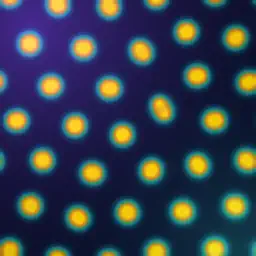
Turing Pattern Grow is a reaction-diffusion simulation game built on a 1952 paper by Alan Turing — not the Turing machine paper, not the Enigma work, but the most important paper of his life that almost nobody has read: The Chemical Basis of Morphogenesis. Turing's question was simple and deep: how does a single fertilised cell, genetically identical to every cell it produces, develop into an organism with spots in the right places, stripes in the right direction, and the correct number of fingers? His answer: two chemicals, diffusing through developing tissue at different speeds, spontaneously break the uniformity of the initial state and produce stable spatial patterns. The faster-diffusing chemical suppresses the slower one at long range. The slower one promotes itself at short range. The tension between local activation and long-range inhibition, and nothing else, is sufficient to produce every pattern in the animal kingdom. The game makes this visible. A simulation canvas fills the screen. Two sliders control the feed rate and kill rate of the reaction. The simulation runs in real time. From a near-uniform field with microscopic random noise, structure emerges: small bright specks appear, grow, compete for space, and settle into a stable pattern. The pattern depends on the parameters. Feed rate 0.037, kill rate 0.060: evenly spaced spots, like a cheetah. Reduce the kill rate to 0.055: the spots elongate, merge, become winding stripes. Reduce it further: the stripes fold into a labyrinthine maze identical to a human fingerprint. One model. Two numbers. The difference between a leopard and a fingerprint. Eight levels move through the six pattern types the model produces. Spots, stripes, labyrinths, holes, self-replicating spots, and traveling waves. Each level shows a target biological pattern — a photograph of a real organism — and asks the player to find the parameter combination that produces it. After each match, a card explains the biological mechanism behind that organism's pattern and the experiment that confirmed it. The experimental confirmations are real. A 2009 study showed that removing the inhibitor cell population from a developing zebrafish converts its stripes into spots, exactly as the model predicts. A 2023 study confirmed that human fingerprints form via the same mechanism, between weeks ten and seventeen of foetal development, determined by the curvature of the fingertip. Every fingerprint on a human hand is a Turing pattern. The mathematics that describes it was published two years before its author died.
Technical Analysis
Package Overview Basic metadata
Bundle ID
com.josephjaifre.turingpatterngrow Current Version 1.0
Minimum iOS 18.0
Package Size App Store Size
Package Metadata 0 / 0 version records
Detailed binary, privacy manifest, framework, and Info.plist results have not been indexed for this package yet. The verified App Store and archive metadata above remains available.
Known Version Records
0 version records with stored package metadata
Stored metadata does not guarantee a package is currently available to download.
| Details | Version / IDs | Version date | Action |
|---|