Preview






Description
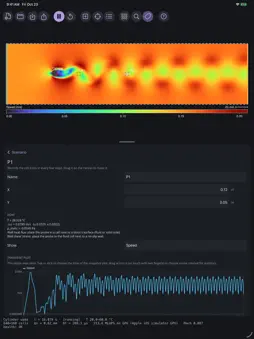
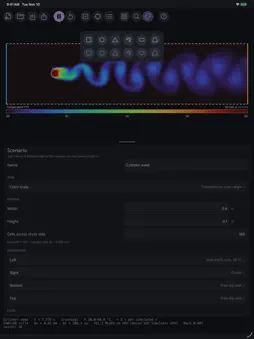
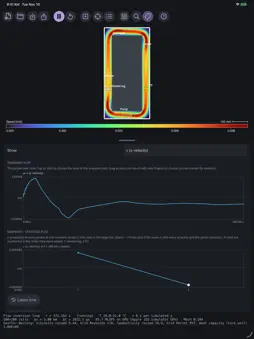
THRUST is a two-dimensional computational fluid dynamics (CFD) solver with conjugate heat transfer that runs live on your iPad. Draw a domain, place solid bodies and heat sources, set the boundaries and press Run: flow and temperature develop on screen while you move blocks, change materials or switch the field you are looking at. SOLVER • Lattice Boltzmann method (D2Q9, two-relaxation-time) for incompressible flow, with an optional Smagorinsky subgrid model for laminar runs. • Conjugate heat transfer: one enthalpy-based lattice spans fluid and solids, so temperature and heat flux are continuous across every interface. • Buoyancy, and temperature- and pressure-dependent properties. • Optional turbulence models: mixing length, standard k-ε or SST k-ω, with wall functions for velocity and heat, wall roughness and optional buoyancy production of turbulence, and SST k-ω with laminar–turbulent transition. • Boiling and condensation (optional, for pure fluids such as water): boiling at heated walls, condensation in colder liquid, film boiling and rewetting, with vapor carried and drifting in the liquid. • Grid refinement: finer cells, up to three levels, around chosen walls and blocks. • Runs on the iPad's GPU through Metal, about 130–180 million lattice updates per second on an iPad mini (A17 Pro). SET-UP • Boundaries: inlets with uniform, parabolic or turbulent profiles, outlets, no-slip and free-slip walls that can be heated or held at a temperature, open boundaries to still surroundings, and periodic sides. • Solid blocks (rectangles with optional rounded corners, circles, ellipses, triangles, elbows and polygons) that conduct heat, generate heat or are held at a fixed temperature; fluid blocks that heat or cool the fluid inside them. • Pumps: a fluid block can drive the flow with four-quadrant characteristic curves (head and torque, edited in the app or imported from CSV), at a set speed, coasting down after a trip, or following its own inertia. • Flow resistances: a loss coefficient on a fluid block stands in for a blockage, a screen or a valve. • Time tables: heat sources, temperatures, loss coefficients, inlet flows and wall heat can follow a table over time, for transients such as a power ramp or a closing valve. • Fluids: air and water tables built in, plus 127 fluids from the CoolProp library. • Materials: 37 metals, alloys, ceramics, glasses and plastics from published tables, an insulator, or your own. RESULTS • Fields: temperature, speed, gauge, static, dynamic and stagnation pressure, total head, vorticity, the turbulence model's k and ε or ω, wall y⁺, the vapor void fraction, and velocity vectors and streamlines. • Probes with time histories, snapshots and statistics, including wall heat flux, wall shear stress, y⁺ and void fraction. • An exact energy balance: heat in through each edge, heat generated, heat stored and heat taken up by boiling. • Export images, field data (CSV, VTK for ParaView), and probe and energy histories (CSV). • Save a run with its results and continue it later, or on another device. VALIDATED The solver is checked against analytic solutions and published benchmarks, for example natural convection in a heated cavity (de Vahl Davis) within 0.5 % and the vortex-shedding Strouhal number behind a cylinder at Re ≈ 100 (0.168 against 0.164). With boiling, the void along a heated channel follows published measurements at seven pressures without a mean bias. The user guide explains the methods and their limits; its Validation page lists every case. Twenty-two ready-made scenarios: cooled electronics, a heated cavity, cooling fins, a cylinder wake, a backward-facing step, an impinging jet, a ventilated room, a pump loop whose flow reverses, fully developed periodic cells (a heated channel, a ribbed channel, a tube bank, offset strip fins, a heated slot) and four boiling cases. No account, no network connection and no data collection: everything runs and stays on your iPad.
What's New
Version 1.2.2 2026-11-11
• Laminar–turbulent transition: the new turbulence model "SST k-ω + transition" lets boundary layers start laminar and turn turbulent where the flow and the fre...• Laminar–turbulent transition: the new turbulence model "SST k-ω + transition" lets boundary layers start laminar and turn turbulent where the flow and the free-stream turbulence say so, for friction and heat transfer through the transitional range on plates and blades. Every wall is resolved, so it needs fine cells along the walls (use Refine grid); the health list checks the first cell's y⁺ and the cell size. Inlets get Turbulence intensity and Eddy-viscosity ratio fields, and the color scale an Intermittency view. Compared with measured flat-plate transition on the Validation page. • Saved results: Save keeps the run with the scenario (every field, the time reached, probe and energy histories), and Open asks whether to continue it or start over. If the system closes THRUST in the background during a run, the next launch offers to continue it. Export → Scenario with results writes one .thrust file that Open → Import continues on another device. • Periodic boundaries: a side can continue on the opposite side (left with right, bottom with top, or both), driven by a flow rate or a pressure drop, with fully developed heat transfer: one period of a long channel, a row of fins or a tube bank. • Six new scenarios under "Fully developed (periodic)": a heated channel, a turbulent channel, a tube bank cell, a ribbed channel, a heated vertical slot and offset strip fins, each checked against published results. • New block tools: polygons (any straight-sided outline, vertices in a table), ellipses, rounded corners on rectangles, and Repeat, which adds a row of copies of a block, optionally staggered, for fin rows, tube banks and ribs. • Quenching: as a hot wall cools through transition boiling, the boiling curve now follows a published model. A copper block quenched in water reaches its peak heat flux close to the measured one and quenches in 381 s (measured 380 s). • Ready-made scenarios checked again against their references: the heated cavity is the classic benchmark at a Rayleigh number of one million (within 1.3 %); the coolant channel is heated and long enough to compare friction and heat transfer (within 6 %); the flow inversion loop's cooler sits above its heater, so natural circulation continues after the pump stops. • Velocity vectors: a new view on the color scale draws arrows showing the flow's direction, colored by speed. Zoom in for more arrows; in refined bands they follow the finest cells. • Streamlines: a second flow view on the color scale draws evenly spaced lines along the flow, colored by speed, so eddies and recirculation stand out. • Health list: "Floor near walls" shows where the stability floor's viscosity dominates next to walls with a turbulence model. The status line estimates a run's cost in time per simulated second. • Grid refinement with k-ε or SST: runs on the CPU and on the GPU now give the same result (they differed by up to about 1 % in the turbulence along a refined wall). • Fixed: with boiling on the GPU, k-ε and SST buoyancy production used outdated forces; starting a run with a turbulence quantity on the color scale could close the app; the curve editor's Add Point button shows its icon. • Validation page: transition on a flat plate, the six periodic cases, the backward-facing step averaged over six flow-through times, and the cylinder wake heated and unheated. Technical Analysis
Package Overview Basic metadata
Bundle ID
com.blogspot.inherentsafety.thrust Current Version 1.2.2
Minimum iOS 16.0
Package Size App Store Size
Package Metadata 0 / 0 version records
Detailed binary, privacy manifest, framework, and Info.plist results have not been indexed for this package yet. The verified App Store and archive metadata above remains available.
Known Version Records
0 version records with stored package metadata
Stored metadata does not guarantee a package is currently available to download.
| Details | Version / IDs | Version date | Action |
|---|