
Preview




Description
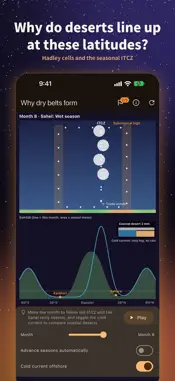
Deserts are always moving. SABAKURAKU is a visual education app for learning the science of drylands by watching and playing. Explore dune landforms, the water balance and the global circulation that creates deserts through beautiful simulations. Eight themes cover everything from high-school geography and earth science to introductory university geomorphology, hydrology and climatology. [Challenges: predict, then test] Take on 40 challenges, five per mode. First predict the result from two choices, then operate the simulation and hold the target state for a few seconds to complete it. You will see whether your prediction was right, with a short explanation. Progress is stored only on your device. [Eight modes] - Dune Formation Change the amount of sand, the wind regime (one, two or many directions) and the wind strength to grow four dune types: crescent barchans, transverse dunes, linear (seif) dunes and star dunes. The model is Werner's (1995) cellular automaton. Fast-forward and a low or high sun are available. - Water Balance and Desertification Compute the aridity index from annual rainfall and temperature, classified by UNEP. Raise grazing pressure and the vegetation suddenly collapses at a tipping point; lowering it again does not bring it back, showing hysteresis. - Oases and Groundwater Change the recharge from the mountains and the number of wells: the water table rises and falls, and when pumping exceeds recharge the spring dries up. Follow the water level and soil salinity on graphs and compare salinization with and without drainage. - Flash Floods (Wadis) Choose the rain intensity and the upstream surface: rain beyond the infiltration capacity (Horton's equation) runs off down the dry riverbed. The hydrograph at a downstream village shows a flood arriving under a clear sky. - Why Dry Belts Form Particles show the Hadley circulation and the subtropical highs. Move through the months and the Intertropical Convergence Zone (ITCZ) shifts north and south, switching the Sahel between wet and dry seasons. A cold current reveals coastal deserts. - Rain Shadow Air rising over a mountain cools at the dry adiabatic rate until clouds form, then at the moist rate. Change the mountain height and humidity to see rain on the windward side and a dry, warm foehn on the lee side. - Dust Storms (new) When the wind exceeds the threshold friction velocity, sand grains start to hop (saltation) and knock fine dust high into the air. Change the wind speed, soil moisture and vegetation to find the conditions for a dust storm. - A Day in the Desert (new) In a dry desert the ground can exceed 60 °C by day and cools sharply at night by radiation. Change the humidity, clouds and ground color and follow on a 24-hour graph how the balance of sunlight and longwave radiation sets the daily temperature range. [Features] - An explanation sheet for every mode - New screens start paused, with the main control highlighted - Undo a reset for a few seconds - Available in more than 70 languages - Portrait and landscape, large text and screen readers supported - Dark and light themes - Works without a connection; every feature is free (banner ads only, no in-app purchases) [Recommended for] - Students of geography, earth science, geomorphology, hydrology and climatology - Anyone who wants an intuitive feel for dunes, desertification, groundwater and dust storms - Teachers looking for classroom material - Anyone who wants to understand news about drought, water shortages and desertification
What's New
Version 2.0.0 2026-11-13
- Two new modes: Dust Storms (when sand hops and dust rises) and A Day in the Desert (the day-night temperature range) - 40 challenges in total - Available in m...- Two new modes: Dust Storms (when sand hops and dust rises) and A Day in the Desert (the day-night temperature range) - 40 challenges in total - Available in more than 70 languages - The official website opened from the app is shown in your language Technical Analysis
Package Overview Basic metadata
Bundle ID
com.fujibit.sabakuraku Current Version 2.0.0
Minimum iOS 15.0
Package Size App Store Size
Package Metadata 0 / 0 version records
Detailed binary, privacy manifest, framework, and Info.plist results have not been indexed for this package yet. The verified App Store and archive metadata above remains available.
Developer Information
Known Version Records
0 version records with stored package metadata
Stored metadata does not guarantee a package is currently available to download.
| Details | Version / IDs | Version date | Action |
|---|