
Preview



Description
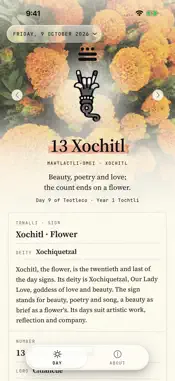
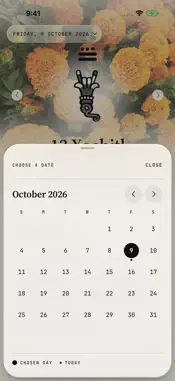
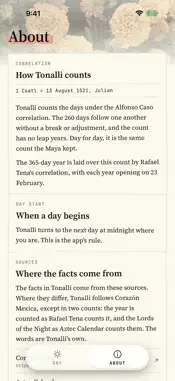
Tonalli shows the tonalpohualli, the Aztec 260-day count, under the Alfonso Caso correlation. It also gives each day its place in the xiuhpohualli, the 365-day year, under Rafael Tena's correlation, with each year opening on 23 February. It opens on today's tonalli: the date, the day's number as a bar-and-dot numeral (a dot is 1, a bar is 5), the day sign's glyph, the day's name, such as 13 Xochitl, and a one-line meaning. Swipe, or tap the buttons beside the glyph, to move a day back or forward; tap Today to return. A small home-screen widget shows today's number, glyph and name on the day sign's photograph, turns to the new day at local midnight, and opens Tonalli on today when tapped. On the Lock Screen, three widgets show today without unlocking the iPhone: a rectangular one with the number, the glyph and the name, a circular one with the number and the glyph, and one beside the date with the number and the glyph. They turn at local midnight too, and a tap opens Tonalli on today once the iPhone is unlocked. Tap the date to open a calendar and choose any date from 15 October 1582 to 31 December 2100. Six cards explain each day: the day sign with its deity and meaning; the number with its Nahuatl name and its lord of the day; the trecena with its ruler and the day's place in it; the veintena with its patron and its feast; the year with its sign; and the Lord of the Night, one of nine. About gives the correlation's anchor, 1 Coatl on 13 August 1521 in the Julian calendar, and the app's rule that a day begins at local midnight. It lists the four sources the facts come from and credits the images; the day-sign glyphs are from the Codex Laud. On Apple Watch, Tonalli opens on today's tonalli too: the date, the day's number, the day sign's glyph, the day's name and its meaning, on the sign's photograph, with buttons beside the glyph to move a day back or forward. Turn the Digital Crown, or swipe up, for three more pages: the sign, the number and the trecena, as the three cards explain them. Tap the calendar button before the date to choose any date from 15 October 1582 to 31 December 2100. The watch app turns to the new day at local midnight on its own. Free, in English with the Nahuatl names. No account and no data collected.
What's New
Version 1.5.0 2026-11-22
Tonalli now gives each day its place in the xiuhpohualli, the 365-day year. A new line under the day's meaning gives its day in one of the eighteen veintenas, o...Tonalli now gives each day its place in the xiuhpohualli, the 365-day year. A new line under the day's meaning gives its day in one of the eighteen veintenas, or in the nemontemi that close the year, and the year's name, such as Day 9 of Teotleco · Year 1 Tochtli. Three new cards follow the trecena card: the veintena, with its dates, its patron and its feast; the year, with the day it opened and what its sign gives it; and the Lord of the Night, one of nine who keep the nights in turn. The card labels now pair a Nahuatl word with the English one, such as Tonalli · Sign; Number keeps its English label. About names the year's correlation, Rafael Tena's, with each year opening on 23 February, and adds Tena, in Rodrigo Martínez's review (INAH), to its sources. The days are still counted under the Alfonso Caso correlation. Technical Analysis
Package Overview Basic metadata
Bundle ID
pro.dreamlabs.tonalli Current Version 1.5.0
Minimum iOS 26.0
Package Size App Store Size
Package Metadata 0 / 0 version records
Detailed binary, privacy manifest, framework, and Info.plist results have not been indexed for this package yet. The verified App Store and archive metadata above remains available.
Known Version Records
0 version records with stored package metadata
Stored metadata does not guarantee a package is currently available to download.
| Details | Version / IDs | Version date | Action |
|---|