Preview




Description
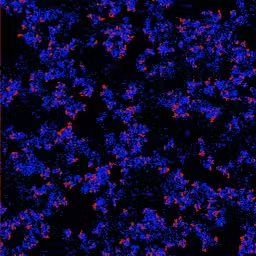
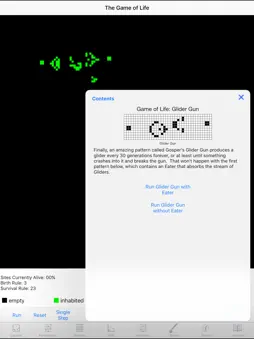
Spatial Population Ecological and Epidemiological Dynamics Simulator (SPEED Sim) is a tool that enables hands-on interactive exploration of the spatial dynamics of various computational models in population ecology and epidemiology. The app also provides several cellular automaton models as an introduction to these kinds of simulations. This app has been used in numerous K-12 educational outreach venues, including: * Expanding Your Horizons workshops to stimulate interest in STEM fields among middle-school girls * 4-H workshops for middle- and high-school students * Workshop at the Maine Science Festival * Various visits to K-12 schools * An exhibit at the Maine Discovery Museum, a children's museum in Bangor, Maine The app currently includes twelve different models: - Conway's Game of Life: a classic cellular automaton that was created by mathematician John Conway in 1970. - Vants: (Langton's Virtual Ants) demonstrates how extremely complex behaviour can arise from a set of very simple rules. - Majority/Voter: models peer pressure, genetic drift or the spread of opinions and ideas. - Diffuse: physics model of particles randomly diffusing around (e.g. particles of ink in a jar of water) - Diffusion-Limited Aggregation: models a process similar to crystallization, with diffusing particles aggregating out of solution. - Cyclic Cellular Automaton: a generalized version of 'rock-paper-scissors.' - SIRS epidemiological model (Susceptible-Infectious-Recovered-Susceptible): demonstrates an infectious disease spreading through a population, where individuals have temporary immunity after recovering from the infection. - Dispersal2: a population model where individuals disperse their offspring at two local scales. - Fragmented Landscape:a population model with local and long-distance dispersal on a spatially structured heterogeneous landscape. - Competitive Species: an extension of the Fragmented Landscape model above, but with two species competing for available habitat with different strategies. - Block Disturbance: a spatial population ecology model where births occur individually, but when death occurs, entire blocks of sites go extinct simultaneously. - Vaccinated Communities epidemiological model: shows how the dynamics of an infectious disease are affected not only by the total amount of vaccination in a population, but also by the variability in vaccination levels among different communities. - Internet Worms: simulates the spread of malicious software spreading through the internet using biologically inspired dispersal strategies. The simulation models allow you to change all parameters controlling the dynamics. Images of the detailed spatial dynamics can be displayed, as well as graphs summarizing the behavior over time. Both types of images can be saved to the Photos library. New patterns can be interactively drawn in the system by simply moving your finger around on the lattice. You can also pinch-to-zoom, and then pan around using two fingers. Most of the models allow you to load images from the camera and run simulations on them. Tap the Options menu at the bottom of the Lattice screen to load images from the camera or the Photos library. For example: load the Diffuse model, turn on Walls mode in the Parameters tab, and then run the model on a photo of yourself. Note that the simulations are generally computational intensive and will run more quickly on newer iOS devices or when you select a smaller lattice size. The speed adjuster brought up from the Options menu near the bottom of the Lattice screen lets you slow down the simulation to observe the dynamics more closely. The larger screen on iPads allows for a much nicer interface, but the app is fully functional on iPhones and iPod Touches as well. This material is based upon work supported by the National Science Foundation under Grant Nos. DMS-0718786 and DMS-0746603 to David Hiebeler.
What's New
Version 2.6 2017-09-13
* Added a model of internet worms, which spread through networks using biologically inspired dispersal strategies. In the model, the colors show the prevalence... Technical Analysis
Package Overview Basic metadata
Bundle ID
edu.maine.umemat.speedlab.SPEEDSim Current Version 2.6
Minimum iOS 8.0
Package Size Latest Recorded Package Size
Package Metadata 2 / 15 version records
Detailed binary, privacy manifest, framework, and Info.plist results have not been indexed for this package yet. The verified App Store and archive metadata above remains available.
Developer Information
Known Version Records
2 version records with stored package metadata • 15 known version records
Stored metadata does not guarantee a package is currently available to download.
| Details | Version / IDs | Version date | Action |
|---|---|---|---|
 12.81 MB | v2.6 App Store ID: 841395977Build: 2.6 | 2021-04-14 23:20:16 | Get Version |
| Not archived | App Store ID: 823624123 | Unknown | Request Version |
| Not archived | App Store ID: 818328845 | Unknown | Request Version |
| Not archived | App Store ID: 812512663 | Unknown | Request Version |
| Not archived | App Store ID: 555462635 | Unknown | Request Version |
| Not archived | App Store ID: 201492632 | Unknown | Request Version |
| Not archived | App Store ID: 171182632 | Unknown | Request Version |
| Not archived | App Store ID: 86972671 | Unknown | Request Version |
| Not archived | App Store ID: 83893156 | Unknown | Request Version |
| Not archived | App Store ID: 39872652 | Unknown | Request Version |
| Not archived | App Store ID: 31092641 | Unknown | Request Version |
| Not archived | App Store ID: 15413118 | Unknown | Request Version |
| Not archived | App Store ID: 11738738 | Unknown | Request Version |
| Not archived | App Store ID: 9820919 | Unknown | Request Version |
 1.04 MB | v1.0 App Store ID: 3722031Build: 1 | 2011-05-12 12:30:08 | Get Version |