Preview






Description
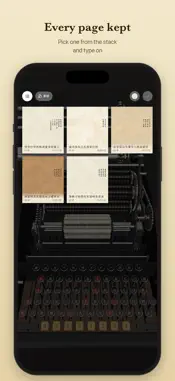
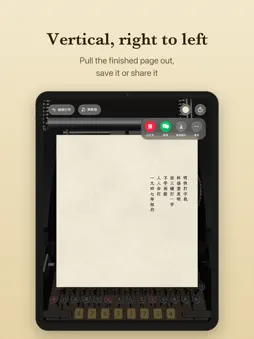
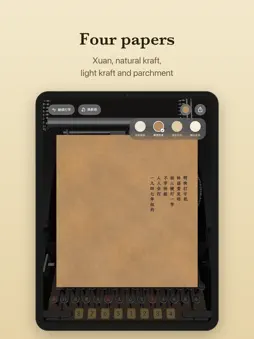
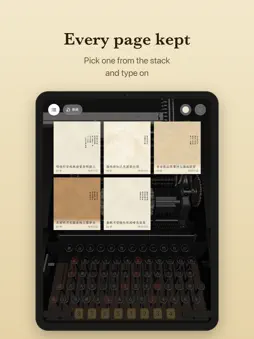
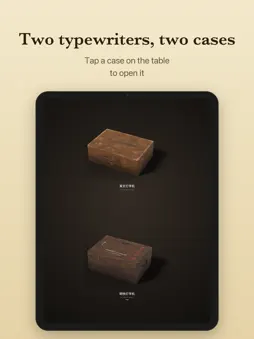
In 1947, in New York, the writer Lin Yutang built a Chinese typewriter and named it MingKwai: "clear and quick". Only one was ever made. Now it is on your screen: lift the hood, press three keys, and type a Chinese character. Not a picture, but a working machine in 3D: every key goes down, the type cylinder turns, the preview drum and the chains follow, the hammer strikes and the paper moves up a character at a time. THE MINGKWAI CHINESE TYPEWRITER • Three keys, one character: a top key for the character's upper-left shape, a bottom key for its lower-right shape, and the magic eye shows eight candidates. Press 1 to 8 to pick one. For example: 清 = 氵 + 月 + 1. • Lift the hood and watch the type cylinder turn to the bar, the preview drum follow on its chain and the carriage slide to the row; the motor and the clutch are in there too. • Turn, tilt and zoom with two fingers to see the machine from any side. • The magic eye's loupe: the candidates enlarged. Tap one to type it. • Look up: enter Chinese text and the typewriter presses every key itself, and shows you how each character is typed. • 72 keys and 36 octagonal type bars, rebuilt from the 1947 prototype and Lin Yutang's US patent. • Vertical columns, right to left, 18 characters each, on to the next column by itself. • More than 4,700 characters, all of the 3,500 most common. The original key assignment is lost; this one is worked out from the structure of the characters. THE ENGLISH TYPEWRITER • A classic portable: type bars fly up from the basket and strike through the ribbon; hold SHIFT and the whole basket drops. • Black and red ribbon, the margin bell, the carriage return and pushing the carriage by hand, as on the real thing. PAPER • Four papers: cream xuan paper, natural kraft, light kraft and warm white parchment. • Pull a finished page out to look at it, save it to Photos or share it. • Every page is kept in a stack. Pick one up and type on. THE MANUAL AND THE STORY • A manual laid out like the original 1947 leaflet, with Lin Yutang's patent drawings. • A timeline from Lin Yutang's birth to the prototype found in a basement and now at Stanford. ON A FOLDING IPHONE On iPhone Duo it is a typewriter. Closed, the outer display is its case: an old wooden box for the MingKwai, a leather one for the English machine; switch them in the corner. Open it like a laptop: the keyboard on the lower half, the paper on the upper half. It works on every other iPhone and iPad too: tap a case on the table to open it. GOOD TO KNOW The app's interface is in Chinese. No account, no network, no data collected, no in-app purchases.
Technical Analysis
Package Overview Basic metadata
Bundle ID
com.duokit.typewriter Current Version 1.0
Minimum iOS 26.0
Package Size App Store Size
Package Metadata 0 / 0 version records
Detailed binary, privacy manifest, framework, and Info.plist results have not been indexed for this package yet. The verified App Store and archive metadata above remains available.
Developer Information
Known Version Records
0 version records with stored package metadata
Stored metadata does not guarantee a package is currently available to download.
| Details | Version / IDs | Version date | Action |
|---|